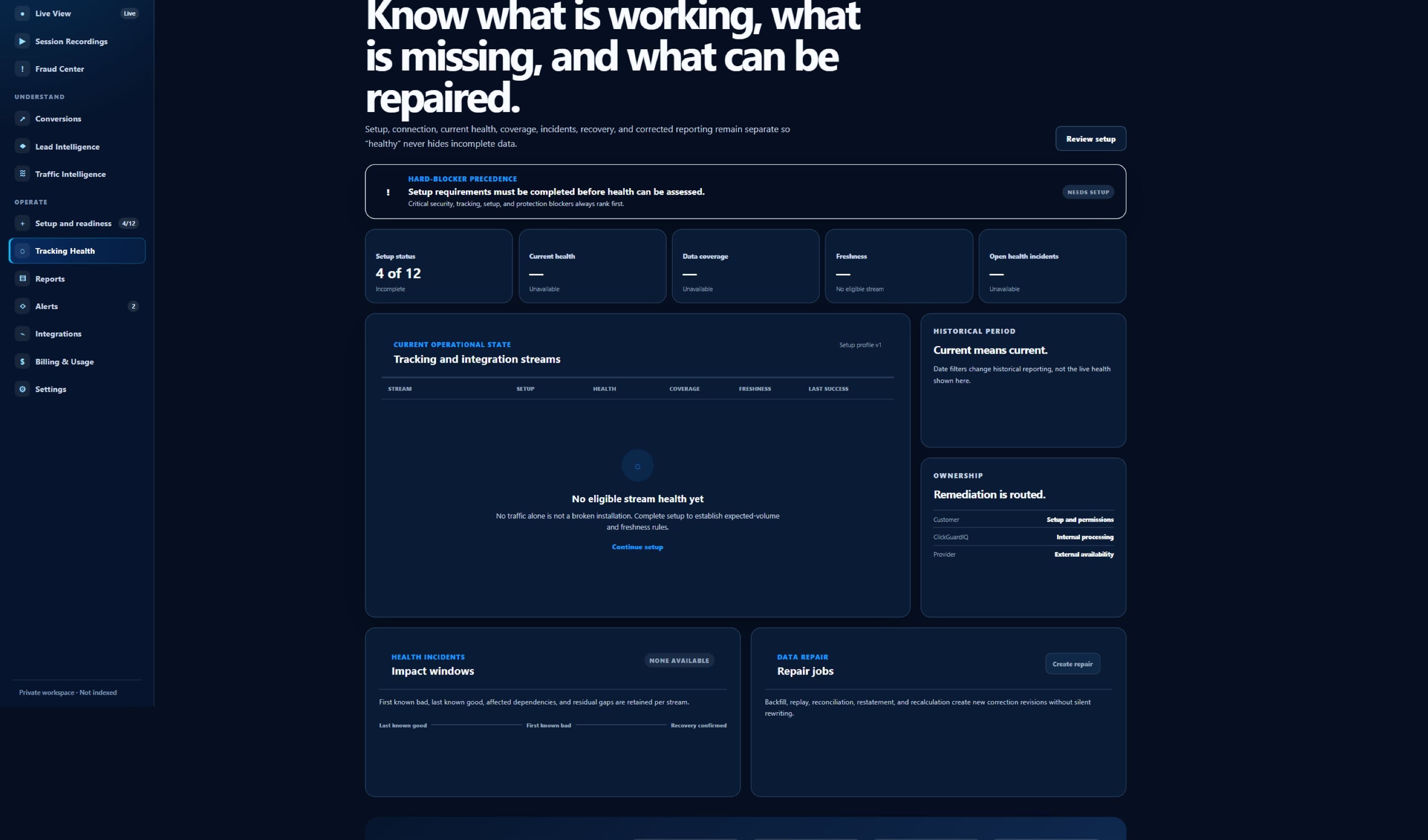
The job this surface owns
Tracking Health is designed for analytics, engineering, growth, and operations teams that need to know whether collection and connected data are ready to support a decision. Its primary record is a property-scoped health model covering setup, consent, acceptance, validation, identifiers, duplication, delay, loss, integration state, incidents, recovery, and repair. That focus matters because a useful operating surface should answer a specific question before it asks a team to act. Here, the question is whether data is ready for its intended use, degraded with disclosed impact, unavailable, recovering, or requires a permitted remediation. The answer stays attached to the evidence and scope that produced it.
Health remains bounded by website, environment, expected event and identifier contract, consent mode, ingestion stream, integration, incident interval, and last trustworthy state. That scope travels with summaries, filters, exports, and follow-up links so a number is not separated from the population it describes. When the required evidence is absent, the interface should say that the answer is unavailable or incomplete instead of replacing it with an estimate that looks authoritative.
- Primary record: a property-scoped health model covering setup, consent, acceptance, validation, identifiers, duplication, delay, loss, integration state, incidents, recovery, and repair
- Decision supported: data is ready for its intended use, degraded with disclosed impact, unavailable, recovering, or requires a permitted remediation
- Designed for: analytics, engineering, growth, and operations teams that need to know whether collection and connected data are ready to support a decision
A deliberate evidence boundary
Tracking Health diagnoses measurement readiness; it does not label visitors as fraudulent, grade traffic quality, or interpret missing data as business performance. ClickGuardIQ preserves this distinction because a high-risk signal, an unusual pattern, a tracking defect, and confirmed invalid activity are not interchangeable findings. Each can change what an investigator checks next, but none should silently inherit the certainty of another.
Each incident retains detection source, affected contract, first and last observation, impact, evidence, remediation, recovery, and any data-repair state. The operating record keeps source observations, calculated signals, human notes, decisions, provider responses, and verified outcomes attributable. Corrections create a history rather than rewriting the earlier state, which keeps later reporting and review understandable.
How it fits daily work
Setup checks, incoming events, validation, delay, loss estimates, integration polling, incident detection, backlog recovery, and repair verification have separate update cycles. This prevents a recent partial stream from being compared casually with a completed historical period. It also gives an operator a direct route to the underlying visitor, session, incident, conversion, lead, campaign, integration, or delivery record when more detail is justified.
Installation details, security configuration, diagnostic payloads, integrations, repair actions, and environments remain limited to authorized roles and safe disclosure. Access is therefore part of the product model, not an afterthought. Sensitive evidence, exports, provider actions, and administrative changes should remain limited to the appropriate website, client, role, and purpose, with an audit trail that explains who did what and when.