Color theme
Sign inRequest beta access

Built for your workflow

Protect conversion analysis from questionable outcomes.

Review the visitor and evidence behind conversion occurrences while preserving counting, attribution, qualification, and value rules.

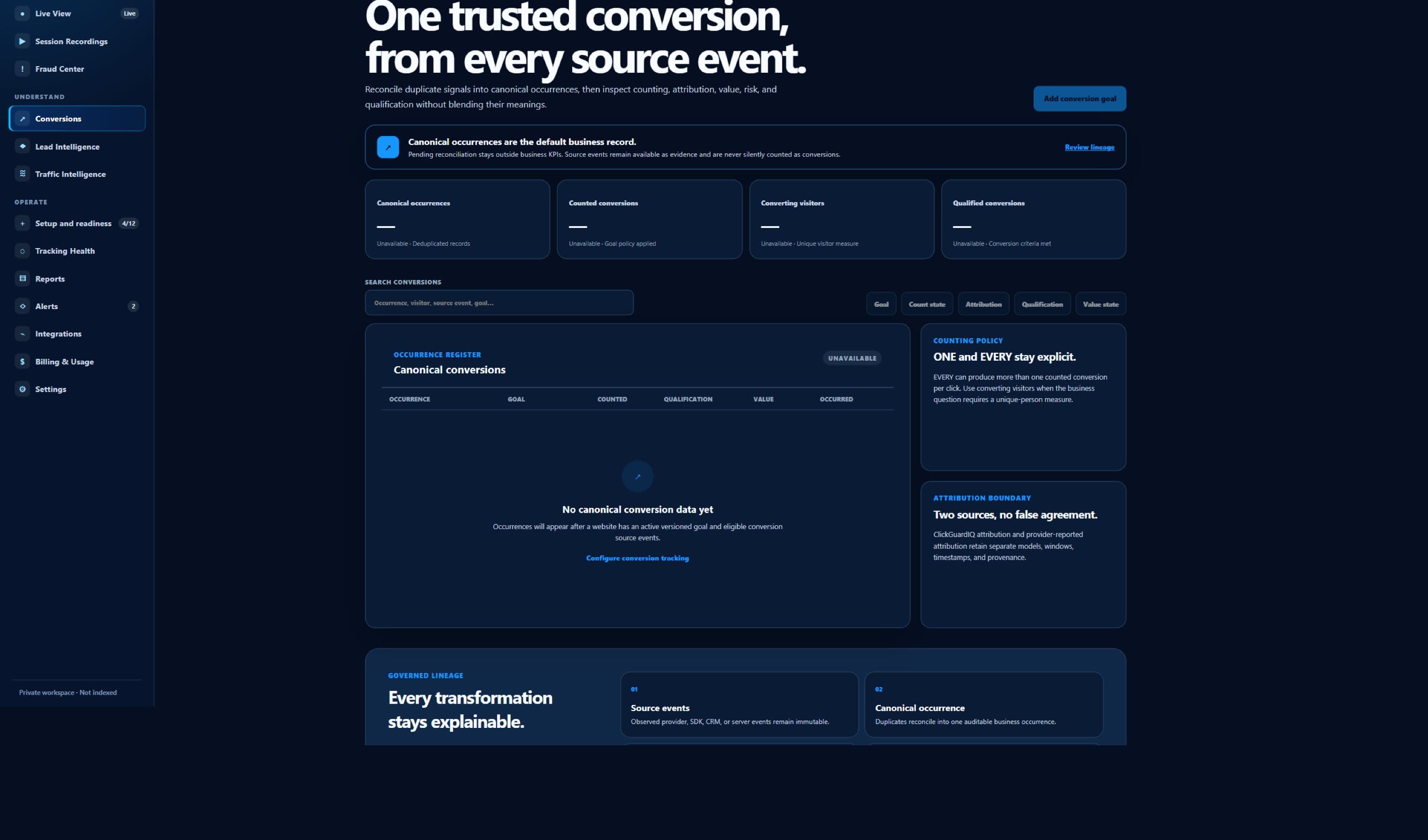
Sanitized beta interface — no customer data
Sanitized ClickGuardIQ Conversions workspace showing current readiness information.
ConversionsCurrent beta interface captured without customer conversion or revenue data.

Recognize the operating problem

Conversion Fraud Detection starts with a question the evidence can actually answer.

The solution is framed around the buyer's decision, the measurable population, and the operational boundary—not an unsupported savings or detection promise.

What teams are trying to solve

A questionable conversion can come from suspicious traffic, duplicate events, tracking defects, attribution differences, incentive behavior, low business quality, later refund, CRM correction, or a definition that no longer matches the business question. The page is designed for analytics, growth, paid-media, fraud, and revenue teams reviewing questionable conversion outcomes. It begins with the operational question rather than assuming every unusual pattern has the same cause or deserves the same response.

A useful solution must show which records belong to the question, which evidence is eligible, which data is missing, and what decision is permitted next. The review remains bounded by property, conversion definition and version, occurrence and source times, identity confidence, counting window, attribution model, currency, eligibility, and reconciliation state. That context remains visible when a user filters, compares, investigates, exports, or follows a link into another product surface.

Before configuration, the team should document its current data sources, ownership, review threshold, response authority, and exception process. That baseline lets the beta review distinguish a missing product capability from incomplete measurement, an external dependency, or an operating-policy decision that belongs to the customer.

What a defensible outcome looks like

A defensible outcome begins with one canonical conversion occurrence, preserves its source events and reconciliation, and keeps counting, attribution, qualification, risk, value, CRM outcome, and downstream eligibility independent. The outcome is not one universal score. It is an attributable path from measured evidence to a qualified conclusion, with confidence and limitations visible at the moment the team decides what to do.

The decision supported by this solution is whether a conversion occurrence is validly measured, needs reconciliation, remains questionable, is confirmed under policy, qualifies for a business metric, or should enter a governed downstream workflow. When evidence is insufficient, conflicting, stale, or outside the selected scope, the product should preserve an unavailable, unclassified, or needs-review state rather than manufacture certainty.

Success criteria should be agreed before the evaluation window opens. Reviewers can then test whether another authorized operator can reproduce the population, read the reasons and limitations, reach a policy-supported decision, and trace every later handoff without relying on undocumented assumptions.

  • Audience: analytics, growth, paid-media, fraud, and revenue teams reviewing questionable conversion outcomes
  • Decision: a conversion occurrence is validly measured, needs reconciliation, remains questionable, is confirmed under policy, qualifies for a business metric, or should enter a governed downstream workflow
  • Scope: The review remains bounded by property, conversion definition and version, occurrence and source times, identity confidence, counting window, attribution model, currency, eligibility, and reconciliation state.

Where the solution stops

Conversion Fraud Detection does not let a risk score silently delete an occurrence, rewrite revenue, choose universal attribution, or prove that an optimization destination used a delivered signal. This protects the buyer from a common failure: treating detection as confirmation, a recommendation as an applied action, or an applied action as a verified commercial result.

Conversion Intelligence owns the occurrence and definitions, Visitor Intelligence owns the measured journey, Fraud Center owns confirmation, and Optimization Signal Protection owns destination eligibility and delivery history. The solution therefore links to the relevant Platform record, methodology, provider status, privacy control, or reporting surface when the next question belongs there. That division keeps each page useful without pretending one workflow replaces the whole operating stack.

If a required provider field, identity key, permission, event, outcome, or correction path is unavailable, the responsible result is a disclosed limitation and a narrower supported workflow. It is not a silent estimate, fabricated connection, automatic fraud verdict, or promise that operational action produced financial value.

Solution capabilities

What Conversion Fraud Detection helps the team do.

Capabilities are described through evidence and workflow behavior. They do not imply unsupported provider access, automated blocking, or guaranteed performance.

Review one canonical occurrence

Connect eligible browser, server, provider, import, or CRM events to one governed occurrence while retaining every source and reconciliation choice.

Version conversion definitions

Show occurrence, count, qualification, attribution, and destination-eligibility rules, effective time, and historical comparability.

Connect the measured journey

Link acquisition, property-scoped visitor, sessions, events, consented recording, and known tracking gaps without rewriting the occurrence.

Separate risk and qualification

Keep validity, business qualification, risk, value, revenue, CRM status, and sales outcome as independent evidence-bearing decisions.

Compare attribution honestly

Present internal and provider-native views with model, lookback, timezone, eligible touchpoints, identifiers, freshness, and limitations.

Retain correction history

Link refund, cancellation, duplicate resolution, CRM disposition, identity correction, recalculation, and supported destination update.

Practical situations

Use the solution when the business question needs a traceable answer.

Each situation begins with a recognizable operating problem and ends with a qualified next step—not a fictional customer result.

Duplicate conversion events

Review identifiers, source systems, timestamps, definition version, deduplication evidence, and ambiguity before resolving the canonical occurrence.

Risky conversion with recorded value

Investigate the journey and incident while preserving occurrence, attributed value, qualification, CRM state, refund, and correction independently.

Provider attribution disagrees

Compare identifiers, eligible touchpoints, lookback, timezone, event time, consent, import delay, and model instead of declaring one view universally wrong.

A later refund changes quality

Attach the external correction to the occurrence, retain prior reporting and delivery state, and rebuild affected governed summaries.

From question to decision

A governed conversion fraud detection workflow.

Measurement, calculation, investigation, decision, action, and verification remain distinct so teams can explain the path and correct it later.

  1. 01

    Validate source events

    Retain property, source, identifiers, occurrence and receipt time, definition, consent, validation, and provenance for every candidate event.

    A received event is not automatically a unique or qualified conversion.
  2. 02

    Resolve the canonical occurrence

    Apply versioned identity and deduplication rules, preserve ambiguous candidates, and record why the occurrence was created or corrected.

  3. 03

    Attach journey and risk evidence

    Review acquisition, visitor, sessions, tracking, behavior, incidents, confidence, coverage, and known limitations.

  4. 04

    Count, attribute, and qualify

    Apply explicit independent definitions for reporting, attribution, business qualification, value, risk decision, and CRM state.

  5. 05

    Reconcile and govern delivery

    Process later outcomes and corrections, retain history, and route only supported eligible signals through accountable destination states.

Evidence and readiness

Know what is real, beta, limited, or provider-dependent.

Public product captures are sanitized, conceptual art is labelled, and external capabilities require validation for the proposed account and workflow.

Product evidenceavailable

Sanitized Conversion Intelligence

The capture contains no customer conversions, revenue, attribution, risk, qualification, fraud, or uplift result.

Occurrence modelbeta

Governed beta reconciliation

Canonical occurrence, definition version, independent dimensions, and correction history are defined; source coverage requires validation.

External outcomesexternal

Provider and CRM dependent

Attribution, refunds, stages, values, corrections, and identity keys depend on supported fields and connection health.

Optimizationlimited

Delivery is not destination use

An eligible or accepted signal does not prove provider processing, model influence, savings, or campaign improvement.

Compare operating behavior

Evaluate Conversion Fraud Detection beyond a feature checklist.

The comparison is qualified and approach-based. It does not claim that every alternative product behaves the same way.

Evaluate Conversion Fraud Detection beyond a feature checklist.
ComparisonEvent-level fraud filterOccurrence-level conversion review
RecordTreats every browser, server, or provider event as another conversion.Resolves source events into one canonical occurrence with retained deduplication and reconciliation history.
DefinitionUses one conversion label for counting, attribution, qualification, risk, and value.Versions each definition independently and discloses which population it changes.
RiskDeletes or devalues the occurrence when risk crosses one threshold.Keeps occurrence, validity, qualification, risk, value, and CRM outcome distinct.
AttributionPresents one model or provider total as objective truth.Shows model, lookback, timezone, touchpoints, source coverage, and provider-native views separately.
CorrectionOverwrites duplicates, refunds, or CRM outcomes in the latest total.Retains source, prior state, reason, time, correction, delivery history, and affected recalculation.

A buyer-ready evaluation standard

Define success using evidence the organization can verify.

A credible beta evaluation starts with data readiness, decision quality, governed handoffs, and independently checkable outcomes.

Measurement before interpretation

Resolve browser, server, provider, import, and CRM source events into a governed canonical occurrence with versioned deduplication and reconciliation before interpreting conversion risk or quality. Every important result should disclose property or client, period, timezone, filters, eligible population, exclusions, freshness, coverage, and the definition or model version used.

Collection failure, consent exclusions, sampling, provider delay, identity uncertainty, and incomplete external outcomes can all change what the product can conclude. They remain visible at the point of use and in reports or exports so missing evidence cannot look like improvement.

A governed team handoff

Conversion Intelligence owns the occurrence and definitions, Visitor Intelligence owns the measured journey, Fraud Center owns confirmation, and Optimization Signal Protection owns destination eligibility and delivery history. Assignments, notes, approvals, corrections, provider responses, and downstream delivery states remain attributable to the user or system that created them.

A recommendation is not an attempt; an attempt is not provider application; provider application is not verification; and verification is not automatic proof of savings, revenue, lead quality, or optimization impact. Permissions and reversal remain part of the path wherever action is supported.

Proof without invented outcomes

Evaluate whether the team can reconstruct an occurrence, explain every count and attribution view, preserve corrections, distinguish risk from business qualification, and verify downstream delivery without invented uplift. The evaluation should identify the evidence available before activation, the decisions operators must reproduce, the unsupported requirements that must stop the workflow, and the outcome checks the organization controls.

This page does not use invented testimonials, logos, reviews, benchmark statistics, detection rates, recovered-spend totals, conversion uplift, or sales claims. A public screenshot demonstrates interface readiness only; it never substitutes for a customer result or provider verification.

Conversion Fraud Detection questions

Clarify fit, limitations, and the next responsible step.

The answers describe the intended beta operating model and avoid promising integrations or outcomes that have not been validated.

What is the difference between a conversion event and occurrence?

An event is a source observation from a browser, server, provider, import, or CRM. A canonical occurrence is the governed representation of one conversion after eligible events and duplicates are reconciled. The source history remains visible.

Does high risk invalidate a conversion automatically?

No. Risk can support investigation or policy, but it does not silently remove the occurrence, business qualification, value, CRM outcome, provider record, or attribution view. Any correction needs a source, reason, and history.

Why do attribution systems disagree?

They can use different identifiers, touchpoints, lookback windows, event times, timezones, consent coverage, deduplication, imports, adjustments, and models. The conditions should be compared explicitly rather than hidden.

Can refunds and cancellations be reconciled?

They can be linked as later external outcomes when the source, identity, fields, timing, permissions, and integration are validated. The earlier occurrence and prior reports remain attributable.

Can qualified conversions be sent to ad platforms?

Only through a supported, policy-approved destination with explicit identifiers, fields, eligibility, attempt, response, acknowledgement, processing, failure, correction, and reconciliation states. Delivery does not prove provider use.

Does the solution promise conversion uplift?

No. The page makes no conversion volume, revenue, uplift, recovery, benchmark, customer-result, or optimization-performance claim. Evaluation should use the organization's own verifiable data quality and workflow outcomes.

Evaluate fit without overpromising

Define the occurrence before deciding whether an outcome is questionable.

Share event sources, identifiers, deduplication, definitions, attribution, qualification, CRM outcomes, values, risk policies, and destinations. The beta review will map current reconciliation support.