Color theme
Sign inRequest beta access

Learn with clarity

Research framework

Use dated, sourced research without turning estimates into universal facts.

Research pages will separate source findings, ClickGuardIQ analysis, methodology, geography, sample, date, limitations, and interpretation.

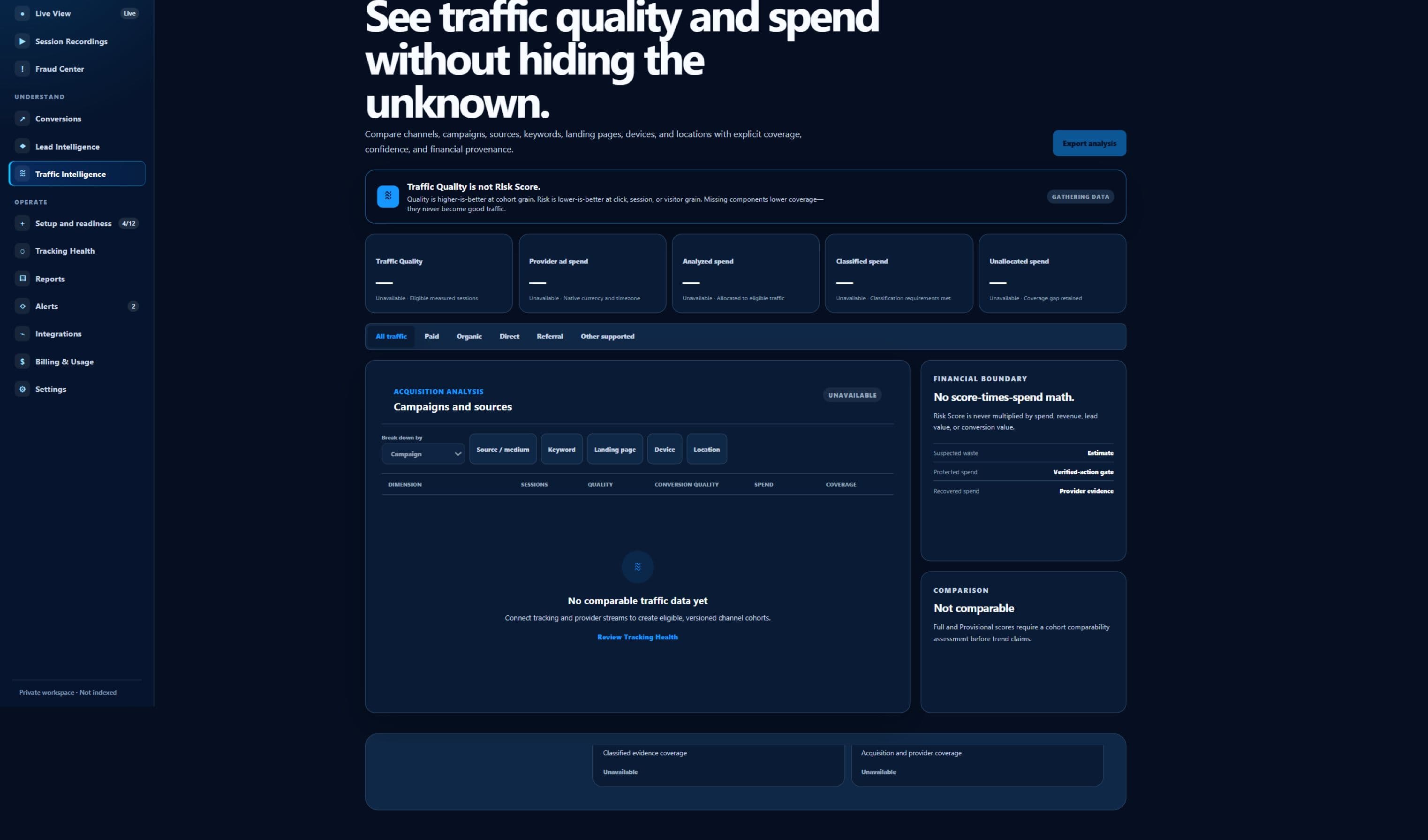
Sanitized beta interface — no customer data
Sanitized ClickGuardIQ Traffic Intelligence workspace showing current data readiness.
Traffic IntelligenceCurrent beta interface captured without fabricated campaign or traffic-performance data.

Learn before deciding

Click Fraud Research and Statistics is organized around questions, evidence, and a responsible next step.

The resource exists to help a reader understand and evaluate—not to turn uncertainty into fear or disguise commercial claims as education.

What this resource helps readers do

The research framework helps readers evaluate a claim by tracing it to the original source, population, period, geography, platform, definitions, sample, method, uncertainty, limitations, and appropriate interpretation. The primary audience is researchers, buyers, advertisers, agencies, analysts, journalists, content teams, and decision-makers evaluating traffic-quality evidence and market claims. Content begins with the reader's real task, defines the relevant terms, and identifies which product, provider, legal, privacy, or business decision remains outside the article or guide.

A useful answer explains the eligible evidence, population, grain, timeframe, geography where relevant, definition, method, uncertainty, limitations, and practical sequence. It also links to the workflow or product surface that owns the next operational question instead of repeating a generic conversion pitch.

  • Audience: researchers, buyers, advertisers, agencies, analysts, journalists, content teams, and decision-makers evaluating traffic-quality evidence and market claims
  • Learning goal: The research framework helps readers evaluate a claim by tracing it to the original source, population, period, geography, platform, definitions, sample, method, uncertainty, limitations, and appropriate interpretation.
  • Boundary: The page does not publish a global click-fraud rate or market-loss statistic as a ClickGuardIQ fact because definitions, samples, incentives, geography, platforms, methods, and dates are not universally interchangeable.

How evidence is handled

Primary provider, standards, government, peer-reviewed, or original research is preferred; secondary summaries are used only when their role and distance from the evidence remain clear. Material factual claims should identify the publisher, source, relevant publication or update date, and the context in which the finding applies. Primary provider, standards, government, or original-method sources are preferred where available.

ClickGuardIQ separates what a source directly found from editorial summary, product methodology, inference, comparison, and recommendation, and it does not convert estimates into observed customer outcomes. Observed activity, calculated metrics, signals, risk, suspicion, policy classification, provider action, verification, estimates, credits, savings, conversion quality, and commercial outcomes retain different meanings throughout the resource family.

What the resource does not claim

The page does not publish a global click-fraud rate or market-loss statistic as a ClickGuardIQ fact because definitions, samples, incentives, geography, platforms, methods, and dates are not universally interchangeable. A guide can help structure an evaluation, but it cannot confirm a specific visitor's intent, replace provider policy, create unavailable product capability, provide legal advice, or guarantee detection, blocking, savings, conversion, lead, revenue, or ROI outcomes.

Content states publication or modification context, visible limitations, related definitions, and the safest next step. If a material source, provider behavior, product capability, or interpretation changes, the correction should update the visible content and date without pretending the earlier publication never existed.

What you can learn

Explore the core areas within click fraud research and statistics.

Each pathway is specific enough to answer a reader question and broad enough to connect the answer to methodology, product, privacy, security, or implementation evidence.

Source provenance

Identify the original publisher and evidence, direct URL, authors or organization, publication and observation dates, and later versions or corrections.

Population and sample

Check eligible universe, selection, exclusions, sample size, geography, platform, traffic source, account types, campaign context, and representativeness.

Definitions and labels

Separate click fraud, invalid clicks, invalid traffic, automated activity, suspicious patterns, policy findings, provider filtering, blocked activity, estimates, and realized outcomes.

Method and uncertainty

Review collection, detection or labelling method, thresholds, models, validation, missing data, confidence, error, bias, sensitivity, and known alternative explanations.

Time and comparability

Retain observation period, publication date, provider version, market conditions, currency, timezone, maturity, and whether two results use compatible definitions.

Responsible interpretation

State what the evidence supports, what remains inference, where it can apply, where it should not, and which decision needs local validation.

Start from the task

Choose a path based on what you need to understand or resolve.

Task-led navigation reduces guesswork and keeps definitions, evidence, limitations, and escalation context attached to the problem.

Check a statistic in a vendor claim

Find the original source, verify its scope and method, compare the nearby wording to the actual finding, and reject timeless or global extrapolation without evidence.

Compare two fraud-rate estimates

Align definitions, eligible populations, platforms, geography, periods, methods, samples, confidence, exclusions, incentives, and maturity before treating the numbers as comparable.

Use research in a business case

Separate external context from company-specific baseline, traffic evidence, provider facts, actions, outcome windows, costs, credits, realized recovery, uncertainty, and decision sensitivity.

Publish a new ClickGuardIQ analysis

Define the question and protocol first, retain source and calculation versions, disclose sample and limitations, preserve reproducibility, and review claims before publication.

Evidence-aware learning path

Five stages for using click fraud research and statistics responsibly.

The sequence moves from the reader's question to source review, practical application, validation, and a documented next step without turning education into an unsupported verdict.

  1. 01

    Locate the original evidence

    Follow citations to the primary source, identify publisher, authorship or organization, URL, version, publication and observation dates, and correction history.

    A frequently repeated statistic is not stronger evidence when every citation traces to the same narrow or inaccessible source.
  2. 02

    Reconstruct the research question

    Identify target population, sample, eligibility, geography, platform, period, traffic source, definitions, labels, collection, method, exclusions, and incentives.

  3. 03

    Evaluate uncertainty and bias

    Review missing data, measurement error, selection and survivorship, labelling quality, feedback loops, model validation, sensitivity, confidence, and alternative explanations.

  4. 04

    Compare only compatible findings

    Align definitions, populations, dates, platforms, geography, currency, timezones, maturity, methods, outcomes, and uncertainty before calculating or narrating a difference.

  5. 05

    Publish a bounded interpretation

    Separate source finding, ClickGuardIQ interpretation, local implication, unsupported extrapolation, limitations, date, and the evidence a reader would need before acting.

Publication and product boundary

Know which evidence is published, current, external, limited, or planned.

Visible status helps readers distinguish finished educational material and product documentation from provider-controlled facts, planned capabilities, and unsupported outcomes.

Research standardavailable

Published evaluation framework

The page provides a reusable method for sources, dates, definitions, populations, samples, methods, uncertainty, limitations, comparison, and interpretation.

Primary sourcesavailable

Linked throughout launch articles

Articles cite providers such as Google, standards and security sources such as NIST and OWASP, and other relevant primary materials.

External findingsexternal

Publisher-owned evidence

Source accuracy, methodology, data access, updates, corrections, definitions, and continued availability remain controlled by the original publisher.

Global benchmarklimited

Not asserted

No universal current click-fraud rate, invalid-traffic share, market loss, savings percentage, detection performance, or customer benchmark is published as ClickGuardIQ proof.

Quality review

Evaluate click fraud research and statistics by usefulness and evidence discipline.

The comparison describes editorial approaches; it does not make unsupported claims about every competing resource or publisher.

Evaluate click fraud research and statistics by usefulness and evidence discipline.
ComparisonStatistic-led claim pageSource-and-method research page
SourceCites a secondary article, vendor summary, or undated graphic without reaching original evidence.Links the primary source where available and records publisher, version, dates, authorship or organization, and correction context.
ScopePresents one platform, sample, country, or period as a global current market fact.Preserves population, eligibility, sample, geography, platform, traffic source, period, exclusions, representativeness, and transfer limits.
DefinitionUses fraud, invalid traffic, bots, suspicious activity, blocked clicks, and savings interchangeably.Retains source-native definitions and separates observation, detection, risk, confirmation, action, verification, estimate, credit, and realized outcome.
UncertaintyPublishes a precise percentage without method, confidence, bias, missing data, or alternative explanations.Explains collection, labelling, method, validation, uncertainty, sensitivity, bias, limitations, and evidence that could change interpretation.
UseTurns external prevalence into guaranteed savings or product performance.Uses research as context and requires local compatible evidence for baselines, decisions, actions, outcomes, costs, credits, revenue, and ROI.

Editorial and maintenance contract

A trustworthy resource remains inspectable after publication.

Authorship, review, dates, sources, limitations, corrections, internal links, and assistance safeguards travel with substantive content.

Sources and interpretation

A source is selected because it supports the specific nearby statement—not because its title contains the target keyword. The resource distinguishes what the source directly reports from ClickGuardIQ interpretation, product method, an illustrative example, or a recommendation for evaluation.

Statistics require extra context: publisher, original source, observation and publication dates, sample, geography, platform, eligibility, definition, method, uncertainty, and limitations. A narrow historical estimate must not become a global, current, or universal market fact through repetition.

  • Primary sources where available
  • Source findings separated from interpretation
  • Statistics retain sample, date, geography, and limitations

Authorship, assistance, and corrections

The ClickGuardIQ Editorial Team is a collective author identity for product, research, and editorial review. Named individuals should appear only when real reviewers approve publication and their role can be stated accurately. Automation may help organize drafts or check consistency but is never treated as evidence.

Material corrections should identify what changed, why it changed, the source or evidence reviewed, and the new modification date. Provider-specific instructions and product capability statements require rechecking because APIs, interfaces, policies, fields, permissions, and availability can change.

From learning to action

Internal links should help a reader move between precise definitions, research standards, practical guides, articles, methodology, product modules, integrations, privacy, security, pricing, and contact—without creating near-duplicate pages solely for search traffic.

The final action must match the reader's stage. Educational pages can point to another guide, a glossary definition, documentation, the relevant workflow, an integration-status review, or a beta fit review. They do not use instant purchase, public free-trial, automatic installation, or guaranteed-result language.

Click Fraud Research and Statistics questions

Clarify scope, evidence, maintenance, and the next useful path.

Answers are written for extraction by readers and answer systems while keeping qualification, limitations, and ownership visible.

What is the global click-fraud rate?

There is no single rate that can be responsibly applied to every platform, geography, period, traffic source, account, campaign, definition, detection method, and outcome. A useful estimate must retain its exact source, scope, method, date, uncertainty, and limitations.

Why does ClickGuardIQ avoid large market-loss statistics?

They are often repeated beyond the original sample, definition, geography, platform, period, or model. Even a valid source estimate does not establish a customer's exposure, preventable spend, provider credit, realized recovery, or product performance.

Can two vendor studies be compared directly?

Only after aligning definitions, eligible populations, samples, geography, platforms, periods, traffic sources, data access, detection and label methods, exclusions, confidence, bias, maturity, and incentives. Otherwise a numerical comparison can be misleading.

What counts as a primary source?

It is the closest authoritative publication of the evidence or rule being discussed: for example provider documentation for provider behavior, a standards body for its standard, government data for its release, or the original research report for its findings.

Does ClickGuardIQ use automation in research content?

Automation may help organize sources, check structure, and identify inconsistencies. It is not evidence. Publication still requires human review of the visible claims against the cited sources, methodology, current product status, and limitations.

How should a business use external click-fraud research?

Use it to frame questions and possible risks, not to substitute for a company-specific baseline. Decisions require the organization's own eligible traffic, measurement health, provider context, review policy, actions, mature outcomes, costs, and uncertainty.

Use the next resource that matches your question

Use the source and method before using the number.

Browse articles with visible primary sources, dates, limitations, interpretation, and practical next steps, or review the editorial standard behind them.