Color theme
Sign inRequest beta access

How ClickGuardIQ works

Protection is not complete until the provider state is verified.

Supported Google Ads protection follows capability checks, recommendation, policy decision, attempt, application, verification, outcome monitoring, and reversal.

Sanitized beta interface — no customer data
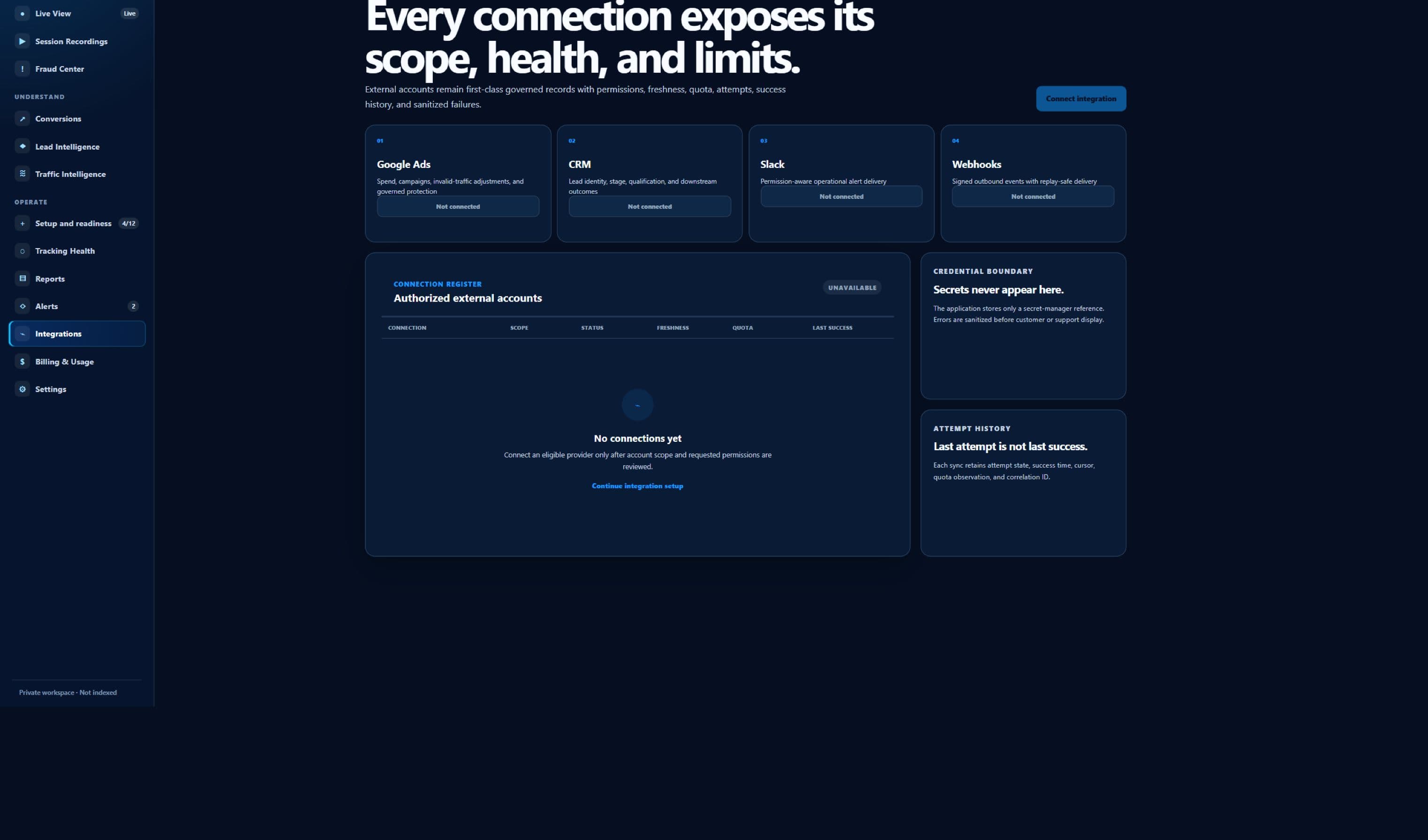
Sanitized ClickGuardIQ Integrations workspace showing provider readiness and setup boundaries.
IntegrationsCurrent beta interface; the capture does not claim a completed provider connection or verified action.

A reproducible operating method

Google Ads Action and Verification begins with scope, provenance, and a permitted decision.

The method explains what enters the workflow, which transformation occurs, what leaves it, and which conclusion the evidence does not support.

The question this workflow owns

When is a Google Ads protection action supported, who may approve it, what did the provider report, and how can application, verification, failure, expiry, and reversal be distinguished? This page is written for paid-media teams, agencies, operations owners, administrators, auditors, and buyers evaluating how a traffic decision can become a governed Google Ads change. Its owner is the capability, policy, approval, request, provider response, verification, expiry, and reversal sequence for supported Google Ads operations, so adjacent product surfaces can reference the result without silently changing its meaning or authority.

The supported decision is whether a supported Google Ads operation may be recommended, approved, attempted, treated as provider-applied, independently verified where possible, allowed to expire, retried, corrected, or reversed. That decision remains qualified by the selected property or client, eligible population, time window, filters, definitions, coverage, freshness, permissions, and evidence available when the workflow runs.

  • Workflow owner: the capability, policy, approval, request, provider response, verification, expiry, and reversal sequence for supported Google Ads operations
  • Audience: paid-media teams, agencies, operations owners, administrators, auditors, and buyers evaluating how a traffic decision can become a governed Google Ads change
  • Supported decision: a supported Google Ads operation may be recommended, approved, attempted, treated as provider-applied, independently verified where possible, allowed to expire, retried, corrected, or reversed

Inputs retain their original meaning

Inputs include a validated Google Ads connection and account scope, current provider capabilities and permissions, a linked incident and evidence snapshot, approved policy, requested operation, collateral scope, authorization, provider responses, verification observations, and reversal requirements. An observed event, calculated metric, inferred relationship, customer-provided field, provider-reported state, and human decision are different evidence types. The workflow records which type produced each value instead of flattening all of them into a generic fact.

The action record retains connection and account, capability snapshot, policy and evidence version, requester and approver, operation and target, attempt, provider request and response identifiers, errors, applied-state interpretation, verification source, expiry, reversal, and history. Source identity, event time, ingestion time, calculation time, definition or model version, eligible scope, confidence, coverage, freshness, and correction history travel with the result wherever the interface presents it.

Boundaries remain visible

ClickGuardIQ can govern and record supported external requests, but Google owns its API, account permissions, policy, field availability, response semantics, application state, delays, limits, and platform behavior. This distinction prevents collection from being treated as acceptance, a signal as confirmation, a recommendation as execution, an attempt as provider application, or an applied state as a verified business result.

When a required input, permission, provider capability, identity link, outcome, or correction path is missing, the method narrows the supported result or returns unavailable, incomplete, unclassified, needs-review, failed, expired, or unknown. It does not replace missing evidence with an authoritative-looking estimate.

Method capabilities

What the google ads action and verification method must preserve.

These are testable behaviors of the operating model, not claims of guaranteed detection, provider coverage, blocking, savings, revenue, or customer performance.

Validate connection capability

Check current account authorization, permissions, supported operation, target type, required fields, limits, refresh state, and provider availability before recommendation.

Bind action to evidence and policy

Link incident, eligible population, assessment and evidence snapshots, decision, policy version, thresholds, collateral scope, expiry, and reversal requirement.

Enforce authorization

Apply organization, client, website, account, role, purpose, field, operation, approval, automation, and sensitive-action restrictions at request time.

Track every provider attempt

Retain payload fingerprint or safe summary, idempotency, attempt, provider request and response identifiers, status, errors, rate limits, retries, and timing.

Verify applied state separately

Distinguish provider acknowledgement from application and use supported reads or evidence to record verification source, time, result, limitation, and disagreement.

Expire and reverse safely

Keep duration, expiry, replacement, reversal capability, request, provider state, verification, failure, and residual scope linked to the original action.

Questions operators encounter

Apply the method when evidence and system states disagree.

Each scenario illustrates how the workflow should retain uncertainty, chronology, ownership, and a responsible next step.

The provider accepts a request

Record acknowledgement without calling it verified application; follow supported provider state, delay, read-back, account context, and verification evidence.

One operation in a group fails

Retain each target and attempt independently, derive a transparent partial group state, expose errors and retry eligibility, and avoid reporting total success.

Account permission changes

Mark the affected capability unavailable or degraded, stop unsupported attempts, preserve earlier actions, and require reauthorization before a new governed request.

An action must be reversed

Check current provider and target state, reversal support, permissions, collateral scope, approval, request, response, verification, and remaining manual follow-up.

The controlled sequence

Five stages of google ads action and verification.

Stages are linked but not interchangeable. Every handoff carries the evidence snapshot, status, actor, time, limitation, and correction route needed by the next stage.

  1. 01

    Check provider capability

    Validate connection, account, permissions, operation, target, required fields, limits, provider availability, and current state.

    A connected account does not prove every operation, field, target, verification read, or reversal is supported.
  2. 02

    Create the recommendation

    Link eligible evidence, assessment, incident decision, policy version, proposed operation, target, collateral scope, expiry, limitations, and reversal plan.

  3. 03

    Authorize and attempt

    Confirm role and account scope, approval or governed automation, idempotency, payload, timing, then record the external request attempt.

  4. 04

    Interpret provider response

    Store safe request and response evidence, status, errors, limits, retry state, provider identifiers, and the narrowest justified application interpretation.

  5. 05

    Verify, expire, or reverse

    Use supported evidence to record applied state, disagreement, partial result, later verification, expiry, reversal, failure, and compatible effectiveness review.

Evidence and implementation status

Separate the documented method from current product and external readiness.

Status labels distinguish implemented interface evidence, beta behavior, provider dependencies, planned coverage, and known limitations.

Integration surfaceavailable

Sanitized provider-readiness capture

The current capture shows configuration and readiness UI without a customer account, completed connection, provider request, applied change, or outcome.

Action modelbeta

Governed beta state machine

Capability, recommendation, decision, approval, attempt, response, verification, failure, expiry, and reversal states are defined for validation.

Google Adsexternal

Externally controlled capability

API access, fields, permissions, quotas, response semantics, application timing, policy, verification reads, and reversibility remain provider-dependent.

Commercial outcomelimited

No savings or performance proof

No blocked-click total, prevented spend, optimization lift, conversion improvement, causal result, or customer outcome is asserted.

Method quality review

Compare google ads action and verification by reproducibility, not presentation alone.

The comparison describes two operating approaches. It does not assert that every alternative service uses the weaker approach.

Compare google ads action and verification by reproducibility, not presentation alone.
ComparisonRequest-equals-protection reportingGoverned provider action lifecycle
CapabilityAssumes every connected account supports the same operation and verification behavior.Checks connection, account, permissions, operation, target, fields, limits, availability, and current provider state.
AuthoritySends an action whenever a score crosses an internal threshold.Requires linked evidence and decision, policy version, permitted scope, approval or governed automation, expiry, and reversal.
AttemptCounts queued, sent, or acknowledged requests as completed protection.Separates recommendation, approval, request, attempt, provider acknowledgement, interpreted application, and verification.
FailureCollapses partial groups, errors, retries, and unknown states into one success total.Retains each operation, target, attempt, error, rate limit, retry, partial group state, and unresolved result.
OutcomeTreats later media change as proof of savings caused by the action.Uses compatible outcome populations and labels limitations, maturity, confounders, provider facts, expiry, reversal, and causal uncertainty.

Reproducibility and audit standard

Another authorized reviewer should be able to reach the same scoped record.

A useful methodology is inspectable before adoption, reproducible during operation, and correctable after new evidence arrives.

Measurement contract

Action reporting separates recommendations, approvals, requests, attempts, provider acknowledgements, interpreted application, independent verification, failures, retries, partial groups, expiries, reversals, and compatible outcome-review populations. Every summary, comparison, export, alert, and investigation link should preserve the population definition, numerator and denominator where relevant, inclusion and exclusion rules, selected period, timezone, freshness, coverage, and known collection gaps.

The contract also distinguishes event time from receipt, calculation, report, action, provider response, and verification time. This prevents late arrival, retry, deduplication, backfill, reprocessing, or timezone changes from silently altering the apparent sequence.

  • No metric without its population and definition
  • No status without its source and timestamp
  • No comparison without compatible scope and maturity

Version and correction contract

Provider corrections, delayed status, capability changes, permission loss, duplicate or partial operations, verification disagreement, policy change, expiry, and reversal append new states without rewriting the original request or response. Raw source observations remain immutable; derived assessments, annotations, identity decisions, policy decisions, provider results, and outcome checks receive attributable versions or history entries.

A recalculation answers what the current definition would conclude from eligible retained evidence. It does not erase what the earlier version reported at the time. Corrections link the prior state, reason, actor or source, affected scope, new state, and any downstream records that require review.

Evaluation contract

Before beta activation, the organization should name the websites or clients, providers, event sources, consent mode, identity rules, permissions, review owners, policy thresholds, supported actions, expected provider states, verification checks, reversal route, and outcome window required by this workflow.

Evaluation should test data readiness, traceability, reason readability, reproducibility, permission enforcement, failure handling, and correction behavior before it evaluates operational or commercial outcomes. This page supplies no invented testimonial, customer logo, benchmark, detection rate, savings total, conversion lift, revenue result, or provider proof.

Google Ads Action and Verification questions

Clarify the method, its limitations, and the next responsible check.

Answers describe the intended and current beta boundary without presenting planned or external behavior as already verified.

Does a connected Google Ads account support every protection action?

No. Support depends on the current API, account type, authorization, permissions, operation, target, required fields, quotas, provider availability, policy, response semantics, verification reads, and reversal capability. Each proposed workflow requires validation.

Does provider acknowledgement mean the change is applied?

Not necessarily. Acknowledgement, acceptance, queued processing, applied state, read-back, independent verification, failure, expiry, and reversal can differ. The action record should use the narrowest status justified by provider evidence.

Can a risk threshold automatically send an action?

Only if a specifically supported opt-in automation policy also satisfies evidence, confidence, coverage, account capability, permissions, collateral scope, approval rules, limits, expiry, reversal, and audit requirements. Risk alone is insufficient.

How are partial multi-target actions reported?

Every target and operation retains its own request, attempt, provider response, error, retry, applied interpretation, verification, expiry, and reversal. A group summary is derived transparently and does not hide partial or unknown results.

Can every action be reversed?

No. Reversibility depends on the operation, current provider state, target, permissions, API behavior, timing, replacement actions, and policy. The workflow must expose unsupported or manual reversal instead of promising it universally.

Does verification prove financial savings?

No. Verification can support that a provider state matched the requested operation at a time. Savings, spend prevention, traffic quality, conversion impact, optimization performance, and ROI require separate compatible mature evidence and are not guaranteed.

Review the workflow against your operating reality

Validate capability, authority, provider states, verification, and reversal before enabling action.

Share account structure, permissions, required operations and targets, policy, approvals, automation boundaries, expiry, verification checks, failure handling, and reversal requirements. The review will map current and external support.