What teams are trying to solve
Lead-generation businesses must connect paid acquisition to visitor behavior, form or call outcomes, qualification, buyer or CRM feedback, revenue stages, and risk while identities and external outcomes arrive with different confidence and timing. The page is designed for lead-generation companies, acquisition teams, call and form operations, revenue leaders, fraud reviewers, and CRM administrators. It begins with the operational question rather than assuming every unusual pattern has the same cause or deserves the same response.
A useful solution must show which records belong to the question, which evidence is eligible, which data is missing, and what decision is permitted next. The workflow remains bounded by client and website, acquisition source, lead definition, form or call occurrence, identity confidence, consent, score versions, buyer or CRM fields, freshness, maturity, and permissions. That context remains visible when a user filters, compares, investigates, exports, or follows a link into another product surface.
Before configuration, the team should document its current data sources, ownership, review threshold, response authority, and exception process. That baseline lets the product review distinguish a missing product capability from incomplete measurement, an external dependency, or an operating-policy decision that belongs to the customer.
What a defensible outcome looks like
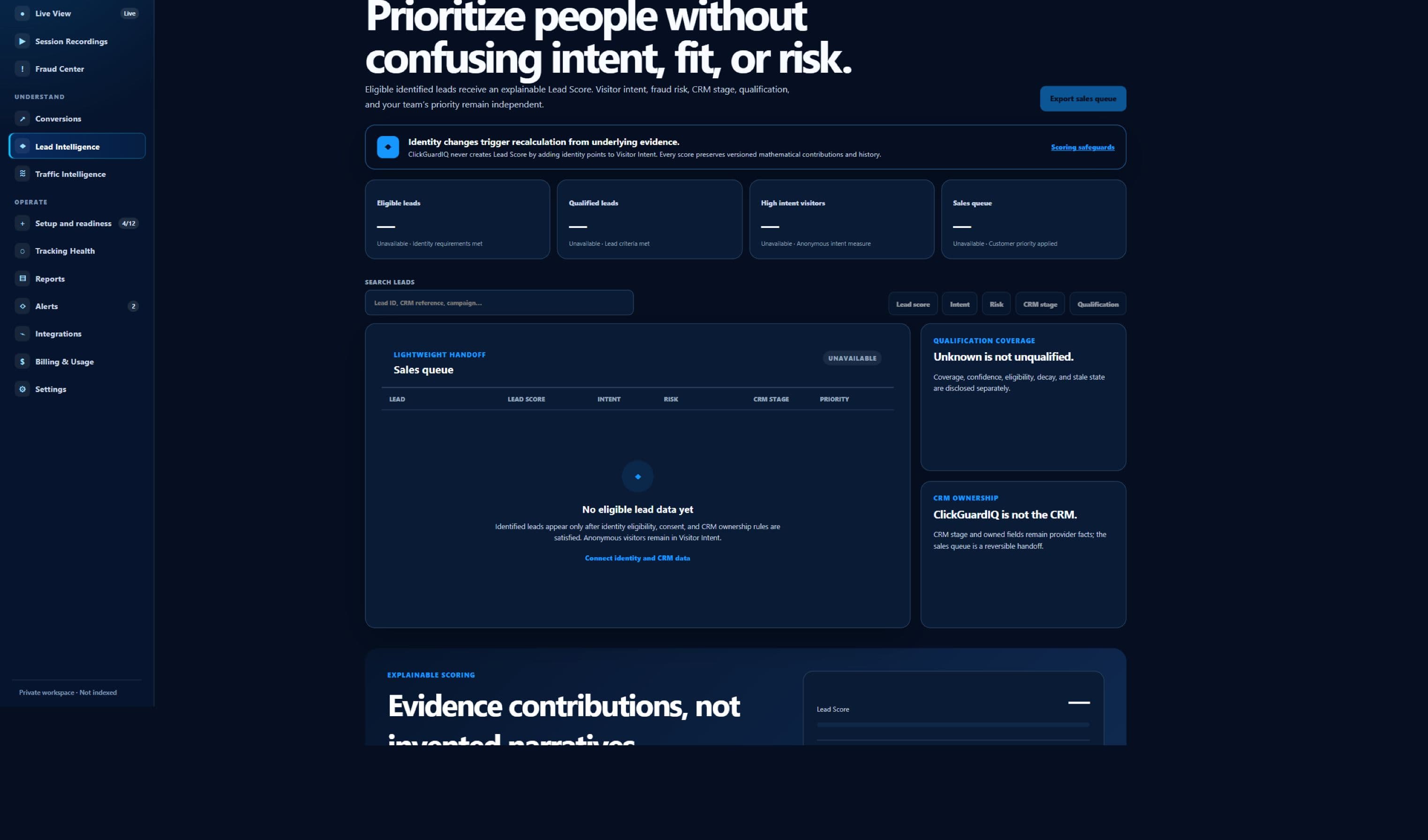
A defensible outcome follows a measured visitor into a governed lead occurrence, keeps intent, quality, qualification, priority, CRM stage, buyer disposition, conversion, and risk separate, and preserves feedback and correction history. The outcome is not one universal score. It is an attributable path from measured evidence to a qualified conclusion, with confidence and limitations visible at the moment the team decides what to do.
The decision supported by this solution is whether a lead should be investigated, qualified, prioritized, routed, withheld from a supported destination, corrected, or included in a mature channel-quality analysis. When evidence is insufficient, conflicting, stale, or outside the selected scope, the product should preserve an unavailable, unclassified, or needs-review state rather than manufacture certainty.
Success criteria should be agreed before the evaluation window opens. Reviewers can then test whether another authorized operator can reproduce the population, read the reasons and limitations, reach a policy-supported decision, and trace every later handoff without relying on undocumented assumptions.
- Audience: lead-generation companies, acquisition teams, call and form operations, revenue leaders, fraud reviewers, and CRM administrators
- Decision: a lead should be investigated, qualified, prioritized, routed, withheld from a supported destination, corrected, or included in a mature channel-quality analysis
- Scope: The workflow remains bounded by client and website, acquisition source, lead definition, form or call occurrence, identity confidence, consent, score versions, buyer or CRM fields, freshness, maturity, and permissions.
Where the solution stops
The solution does not equate a submitted lead with a known person, a low-value disposition with fraud, a high intent score with qualification, or a risk score with automatic rejection or financial impact. This protects the buyer from a common failure: treating detection as confirmation, a recommendation as an applied action, or an applied action as a verified commercial result.
Visitor Intelligence owns the journey, Lead Intelligence owns independent dimensions and feedback, Conversion Intelligence owns occurrences, Fraud Center owns confirmation, and integrations own CRM or destination delivery. The solution therefore links to the relevant Platform record, methodology, provider status, privacy control, or reporting surface when the next question belongs there. That division keeps each page useful without pretending one workflow replaces the whole operating stack.
If a required provider field, identity key, permission, event, outcome, or correction path is unavailable, the responsible result is a disclosed limitation and a narrower supported workflow. It is not a silent estimate, fabricated connection, automatic fraud verdict, or promise that operational action produced financial value.